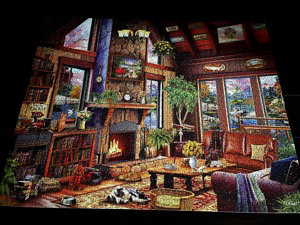
A Puzzling Time
This post contains affiliate links. If you make a purchase through these links, I may earn a small commission at no additional cost to you. I only recommend products I truly love and use.
While TVs, phones, iPads and other electronic devices are good for entertainment, screen overload is real. We’ve all heard that too much screen time is bad for us, but seldom do we seek an alternative to keep our mind busy or stimulated. There’s reading a book, taking a walk, exercising, playing with your kids, meditating, or playing a board game to name a few. While these are all great non-screen alternatives, some of them are short-lasting or not always possible.
Puzzles. Analog puzzles, specifically jigsaw puzzles. When’s the last time you sat down and put together a jigsaw puzzle? Puzzles like this, offer plenty of benefits beyond screen avoidance. The cognitive benefits bring improvements in the form of memory recall, problem-solving, focus and concentration, and visual and spatial reasoning. Additionally, a number of studies claim puzzles can help cognitive function leading to improvements in patients with Alzheimer's and dementia.
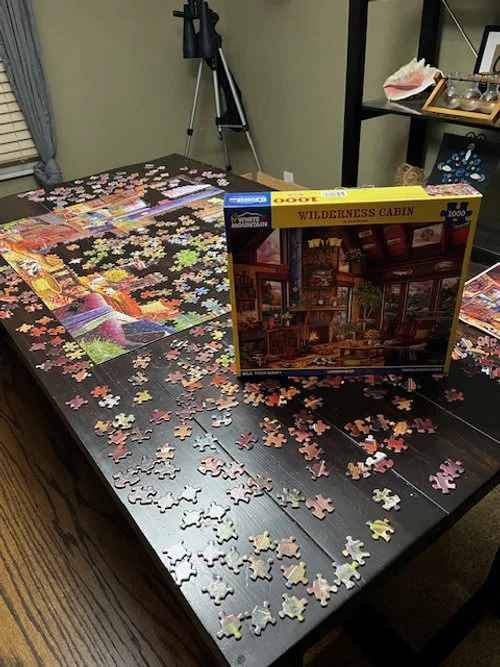
Wilderness Cabin puzzle by White Mountain Puzzles
(work in progress)
According to historical records, jigsaw puzzles have been around since the 18th century, specifically 1760. John Spilsbury is the individual largely credited as the inventor of the jigsaw puzzle. Spilsbury mounted maps on a board and cut them into pieces for children to reassemble, calling them “dissected maps”.
Fast-forward to today and you’ll find our modern-day jigsaw puzzles have likely not changed much. A larger design cut into small pieces with the sole goal on reassembling it. A sense of accomplishment, a completion. Finality. Better yet, it’s not just an individual led task - participation can exist beyond the individual who started it.
I’ll often purchase a puzzle during the holidays, a time when I know I’ll have time to make some progress. A bonus is having a flow of extended family members with fresh minds coming in and out who will often pop a squat and help place a piece or 10. It occasionally resembles a sporting event with different players subbing in and out. I will say that it’s best done in spurts - allowing it to be great enduring and shared activity.
This Christmas, my puzzle search led me to White Mountain Puzzles, based in Jackson, New Hampshire. White Mountain Puzzles started as a poster company in 1978, but later began producing puzzles in the late 1980s. Their selection is vast while boasting their 1000-piece puzzles are the largest in the industry, at 24” x 30” when finished.
All puzzles are interlocking and made of sturdy blue chipboard on recycled paper. The durability on these is legit.
My recommendation is to head on over to White Mountain Puzzles, find a suitable puzzle and get a good spot ready (at least 2 x 2.5 ft!). They do have 300 and 500 piece puzzles as well.
Happy puzzlin’!
We may earn a small commission from purchases made through the below link.